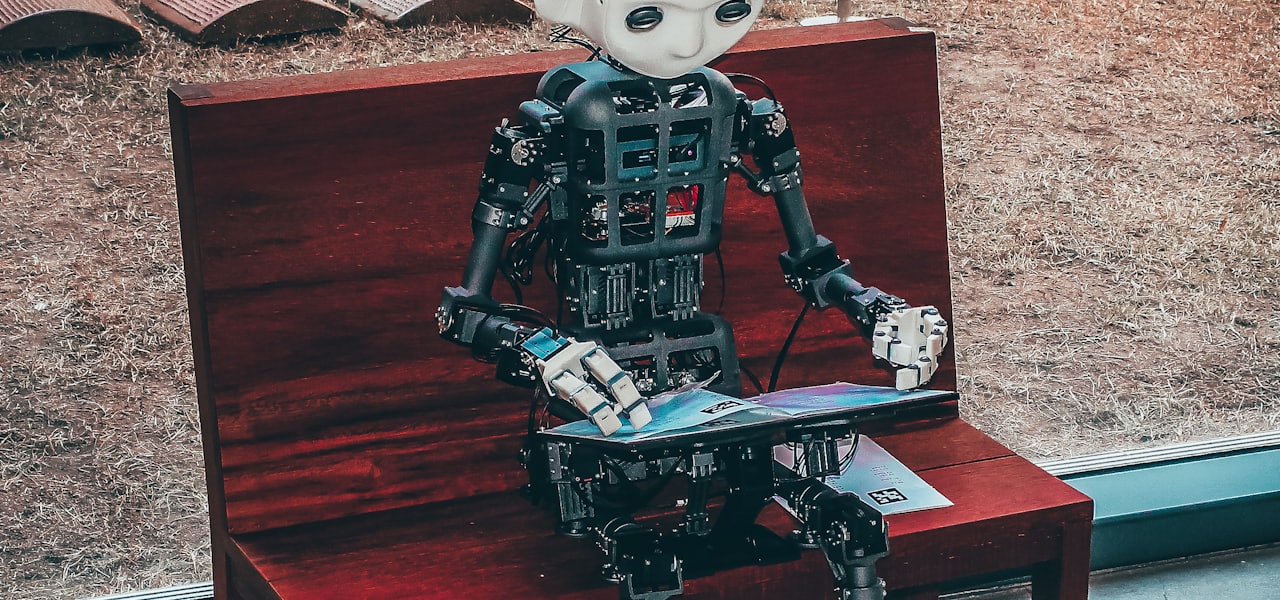
A deadbot, deathbot, or griefbot is a digital avatar, created with artificial intelligence, which resembles a person who is dead. Griefbots employ natural language processing and machine-learning techniques to approximate the style and personality of a deceased person. They may appear as chatbots, voice assistants, or animated avatars, and are often trained on an individual's digital remains. == History == Among the earliest researchers, Muhammad Aurangzeb Ahmad of the University of Washington, developed the Grandpa Bot project, a conversational simulation of his late father designed for his children to interact with. Other efforts include journalist James Vlahos's Dadbot, which evolved into the commercial platform HereAfter AI. Hossein Rahnama's Augmented Eternity research at MIT Media Lab and Toronto Metropolitan University, and game designer Jason Rohrer's "Project December", have enabled users to converse with language-model representations of loved ones. Early commercial projects such as Eternime, founded by Marius Ursache, also popularized the notion of interactive digital immortality. == Cultural and societal impact == Scholars have proposed frameworks and critiques addressing the ethics of these technologies. Tomasz Hollanek and Katarzyna Nowaczyk-Basińska developed a design-ethics taxonomy distinguishing the data donor, data recipient, and interactant. Edina Harbinja and Lilian Edwards formalized the concept of post-mortem privacy, and Carl J. Öhman at the Oxford Internet Institute studied the management of large-scale digital remains. Cultural acceptance varies: while some view them as expressions of remembrance, others regard them as unsettling or ethically problematic. Concerns have been raised about deadbots' potential for creating psychological harm. Griefbots are considered part of the phenomenon of artificial intimacy.
Voyages: The Trans-Atlantic Slave Trade Database
Voyages: The Trans-Atlantic Slave Trade Database is a database hosted at Rice University that aims to present all documentary material pertaining to the transatlantic slave trade. It is a sister project to African Origins. The database breaks down the kingdoms and countries that engaged in the Atlantic trade. By 2008, the project had gathered data on nearly 35,000 transatlantic slave voyages from 1501 to 1867. For each voyage they sought to establish dates, owners, vessels, captains, African visits, American destinations, numbers of slaves embarked, and numbers landed. They have been able to find much of this material for an estimated 80 percent of the entire transatlantic African slave trade. With corrections for missing voyages, the Project has estimated the entire size of the transatlantic slave trade with more comprehension, precision, and accuracy than before. They reckon that in 366 years, slaving vessels embarked about 12.5 million captives in Africa, and landed 10.7 million in the New World. A horrific discovery is a careful estimate that the Middle Passage took a toll of more than 1.8 million African lives. In this quantitative database, the numbers are enslaved people.
T-pose
In computer animation, a T-pose is a default posing for a humanoid 3D model's skeleton before it is animated. It is called so because of its shape: the straight legs and arms of a humanoid model combine to form a capital letter T. When the arms are angled downwards, the pose is sometimes referred to as an A-pose instead. Likewise, if the arms are angled upward, it is called a Y-pose. Generic terms encompassing all these (especially for non-humanoid models) include bind pose, blind pose, and reference pose. == Usage == The T-pose is primarily used as the default armature pose for skeletal animation in 3D software, which is then manipulated to create animation. The purpose of the T-pose relates to the important elements of the body being axis-aligned, thereby making it easier to rig the model for animation, physics, and other controls. Depending on the exact geometry of the model, other poses such as the A-pose may be more suitable for vertex deformation around areas such as the shoulders. Outside of being default poses in animation software, T-poses are typically used as placeholders for animation not yet completed, particularly in 3D animated video games. In some motion capture software, a T-pose must be assumed by the actor in the motion capture suit before motion capturing can begin. There are other poses used, but the T-pose is the most common one. == As an Internet meme == Starting in 2016 and resurfacing in 2017, the T-pose has become a widespread Internet meme due to its bizarre and somewhat comedic appearance, especially in video game glitches where a character's animation is unexpectedly supplanted by a T-pose. In a prerelease video of the game NBA Elite 11, the demo was filled with glitches, notably one unintentionally showing a T-pose in place of the proper animation for the model of player Andrew Bynum. The glitch later gained fame as the "Jesus Bynum glitch". Publisher EA eventually cancelled the game as they found it unsatisfactory. A similar occurrence happened with Cyberpunk 2077. In the 2023 Formula One season, driver George Russell performed a T-pose in the opening credits of the series' TV broadcasts. This quickly became a meme within the motorsports community. Russell repeated the pose after claiming pole position at the 2024 Canadian Grand Prix and winning the 2024 Austrian Grand Prix.
Data administration
Data administration or data resource management is an organizational function working in the areas of information systems and computer science that plans, organizes, describes and controls data resources. Data resources are usually stored in databases under a database management system or other software such as electronic spreadsheets. In many smaller organizations, data administration is performed occasionally, or is a small component of the database administrator’s work. In the context of information systems development, data administration ideally begins at system conception, ensuring there is a data dictionary to help maintain consistency, avoid redundancy, and model the database so as to make it logical and usable, by means of data modeling, including database normalization techniques. == Data resource management == According to the Data Management Association (DAMA), data resource management is "the development and execution of architectures, policies, practices and procedures that properly manage the full data lifecycle needs of an enterprise". Data Resource management may be thought of as a managerial activity that applies information system and other data management tools to the task of managing an organization’s data resource to meet a company’s business needs, and the information they provide to their shareholders. From the perspective of database design, it refers to the development and maintenance of data models to facilitate data sharing between different systems, particularly in a corporate context. Data Resource Management is also concerned with both data quality and compatibility between data models. Since the beginning of the information age, businesses need all types of data on their business activity. With each data created, when a business transaction is made, need data is created. With these data, new direction is needed that focuses on managing data as a critical resource of the organization to directly support its business activities. The data resource must be managed with the same intensity and formality that other critical resources are managed. Organizations must emphasize the information aspect of information technology, determine the data needed to support the business, and then use appropriate technology to build and maintain a high-quality data resource that provides that support. Data resource quality is a measure of how well the organization's data resource supports the current and the future business information demand of the organization. The data resource cannot support just the current business information demand while sacrificing the future business information demand. It must support both the current and the future business information demand. The ultimate data resource quality is stability across changing business needs and changing technology. A corporate data resource must be developed within single, organization-wide common data architecture. A data architecture is the science and method of designing and constructing a data resource that is business driven, based on real-world objects and events as perceived by the organization, and implemented into appropriate operating environments. It is the overall structure of a data resource that provides a consistent foundation across organizational boundaries to provide easily identifiable, readily available, high-quality data to support the business information demand. The common data architecture is a formal, comprehensive data architecture that provides a common context within which all data at an organization's disposal are understood and integrated. It is subject oriented, meaning that it is built from data subjects that represent business objects and business events in the real world that are of interest to the organization and about which data are captured and maintained.
Halloween Problem
In computing, the Halloween Problem refers to a phenomenon in databases in which an update operation causes a change in the physical location of a row, potentially allowing the row to be visited again later in the same update operation. This could even cause an infinite loop in some cases where updates continually place the updated record ahead of the scan performing the update operation. The potential for this database error was first discovered by Don Chamberlin, Pat Selinger, and Morton Astrahan in the mid-1970s, on Halloween day, while working on query optimization. They wrote a SQL query supposed to give a ten percent raise to every employee who earned less than $25,000. This query would run successfully, with no errors, but when finished all the employees in the database earned at least $25,000, because it kept giving them a raise until they reached that level. The expectation was that the query would iterate over each of the employee records with a salary less than $25,000 precisely once. In fact, because even updated records were visible to the query execution engine and so continued to match the query's criteria, salary records were matching multiple times and each time being given a 10% raise until they were all greater than $25,000. Contrary to what some believe, the name is not descriptive of the nature of the problem but rather was given due to the day it was discovered on. As recounted by Don Chamberlin: Pat and Morton discovered this problem on Halloween... I remember they came into my office and said, "Chamberlin, look at this. We have to make sure that when the optimizer is making a plan for processing an update, it doesn't use an index that is based on the field that is being updated. How are we going to do that?" It happened to be on a Friday, and we said, "Listen, we are not going to be able to solve this problem this afternoon. Let's just give it a name. We'll call it the Halloween Problem and we'll work on it next week." And it turns out it has been called that ever since.
Computers & Graphics
Computers & Graphics is a peer-reviewed scientific journal that covers computer graphics and related subjects such as data visualization, human-computer interaction, virtual reality, and augmented reality. It was established in 1975 and originally published by Pergamon Press. It is now published by Elsevier, which acquired Pergamon Press in 1991. From 2018 to 2022 Graphics and Visual Computing was an open access sister journal sharing the same editorial team and double-blind peer-review policies. It has since merged into GMOD, the International Journal of Graphical Models. == History == The journal was established in 1975 by founding editor-in-chief Robert Schiffman (University of Colorado, Boulder), as Computers & Graphics-UK. Schiffman, who co-organized the first SIGGRAPH conference in 1974, had the conference proceedings published as the first issue of the journal. He was succeeded in 1978 by Larry Feeser (Rensselaer Polytechnic Institute). In 1983 José Luis Encarnação (Technische Hochschule Darmstadt) took over. Joaquim Jorge (University of Lisbon) has been Editor-in-Chief since 2007. == Replicability == The journal is working with the Graphics Replicability Stamp Initiative to promote replicable results in publication. == Abstracting and indexing == The journal is abstracted and indexed in: Current Contents/Engineering, Computing & Technology EBSCO databases Ei Compendex Inspec ProQuest databases Science Citation Index Expanded Scopus Chinese Computer Federation/Recommended List of International Conferences and Journals on CAD & Graphics and Multimedia. According to the Journal Citation Reports, the journal has a 2022 impact factor of 2.5.
Period-tracking app
Period-tracking apps are mobile applications used to track the menstrual cycle. They may be used to predict menstruation, to plan fertility, and to track health. Examples include Clue, Glow, and Flo. == Function == Users enter their dates of menstruation, and frequently other experiences such as vaginal discharge and spotting; premenstrual syndrome; changes in mood; menstrual cramps and other pain; and other symptoms such as appetite changes, bloating, and acne. The apps predict the date of users' next period, and often also their ovulation and fertile window. Some apps have additional features such as contraceptive reminders, educational content, tracking modes for use during pregnancy, or the ability to share one's menstrual cycle data with a partner. == Privacy == Period-tracking apps collect personal health data, potentially raising concerns about privacy. Researchers have warned that data may be transferred to third parties and used for consumer profiling and targeted advertising, used for employment and health insurance discrimination, or used to prosecute users for seeking abortions. After the 2022 decision by the United States Supreme Court to overturn Roe v. Wade, and the bans and restrictions on abortion in many US states that followed, many American women uninstalled the apps amidst fear that the data could be accessed by law enforcement and used to prosecute users. WIRED published a ranking of several period-tracking apps by data privacy.